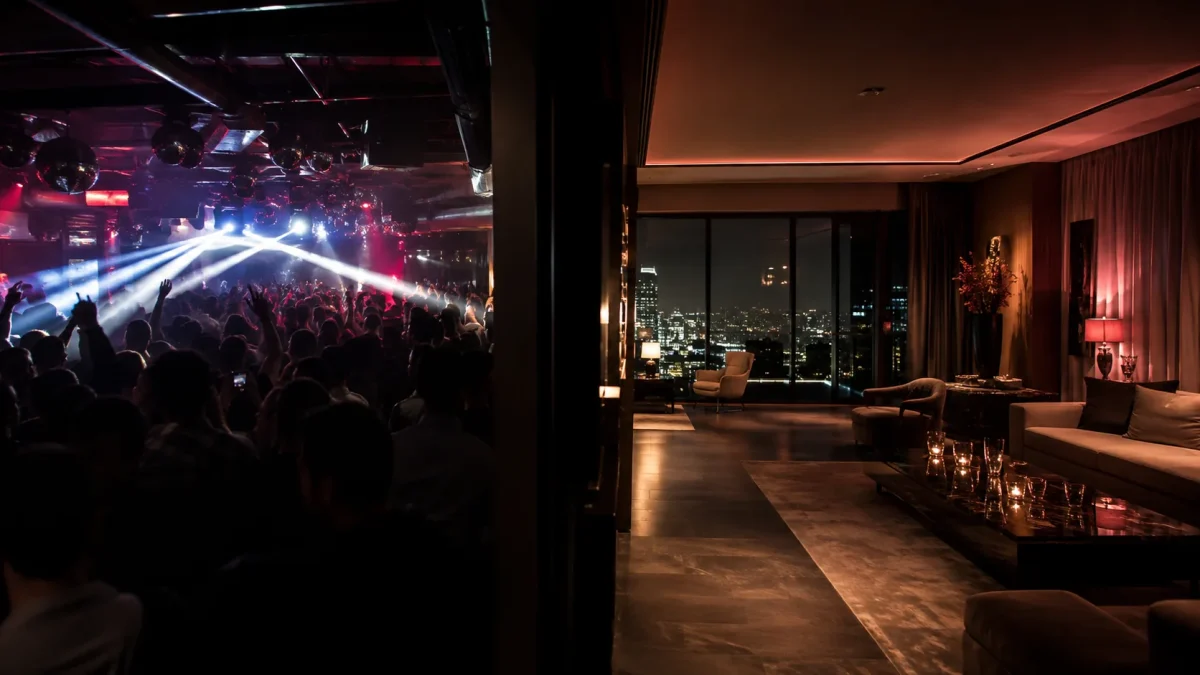
Most groups planning a special night reach the same fork in the road. You can head out to a strip club and let the venue run the evening, or you can book dancers to an apartment, a loft or a villa and run it yourself. Both routes are legitimate, both work, and there is no single answer that fits everyone. What there is, though, is a clear difference between the formats, and it touches almost everything: what the night actually costs, how many people you can bring, whether you can hold a conversation at all, and how everyone gets home at the end. We will go through the differences one by one, without sugar-coating and without a sales pitch, and by the end you will know which format fits your particular night.
Two ways to book dancers for the night
The core difference is not in the show itself but in who holds the wheel. At a club you are a guest inside a system that already exists. There is a schedule you did not set, an order of performances, other tables sharing the same room, and house rules you adapt to. With a private show the situation is completely reversed. You set the hour, the place, the number of people, the music and what happens before and after. The show arrives into your evening instead of your evening slotting into somebody else's timetable.
Everything else follows from that. A group that simply wants to go out and organise nothing will gain from the club, because there really is nothing to arrange. A group with a precise reason for the night, a groom, a milestone birthday, an evening dedicated to one person, will almost always gain from the private format, because you can build the whole evening around that person instead of hoping the venue does it for you.
What dancers really cost: club versus private show
This is where most people are surprised. At first glance going out looks cheaper, because there is no single large sum paid up front. In practice the night is made of many small amounts that quietly add up: entry for each person, a table minimum, drinks at venue prices, rides there and back, and sometimes a surcharge for closer seating. A mid-sized group easily reaches 1,500 shekels and up in a single evening, and that is before anyone orders another round.
With a private show the structure is inverted. There is one known price set in advance according to the format: a solo show starts at 800 shekels, a show with a character and costume at 900, and a bachelor party package at 2,200. Drinks and food are bought at shop prices rather than bar prices, and travel disappears because everyone is already there. The full breakdown sits in the full price list, so you can work out the cost in advance with no surprises at the end.
Group size changes everything
For a couple of friends heading out with no particular reason, a club is convenient. Nothing to arrange, nothing to clean afterwards, you simply show up. The moment the group grows, the picture flips. 10 people at a club end up at two or three separate tables, half of them cannot see whoever is speaking, and the feeling of a shared evening dissolves into parallel conversations. The cost climbs fast too, because every extra person is another entry and another minimum.
The private format works the other way round. The larger the group, the lower the cost per head, because the sum is divided among more participants. 15 people in a loft pay far less each than 15 people going out, and all of them are in the same room watching the same thing. That is exactly why most groups arranging a bachelor party with strippers choose the home format over a night out.
Noise, music and the ability to talk
A club is built to be loud. That is part of its appeal rather than a fault, but it comes at a price. You cannot hold an ordinary conversation, you cannot raise a glass with a toast, and you cannot hear the person sitting two seats away. An evening spent shouting into ears is an evening nobody remembers a single conversation from, and for groups that gathered precisely in order to talk, that is a real drawback.
At home or in a loft you control the volume. You can drop it to background level when people want to talk, push it up when they want to dance, and cut to complete silence a moment before the show begins. That sharp shift from noise to quiet is exactly what builds the moment, and at a club there is simply no way to create it because the sound is not yours to control.
Discretion: who sees you
At a club you are in a public space. There are other people in the room, an entrance everyone passes through, and a fair chance of running into someone you know. For some groups that does not matter at all, and for others it is a central consideration, particularly when the evening involves work colleagues or acquaintances from town.
A private show takes place behind a closed door, and the only people in the room are the ones you invited. Arrival is handled quietly, without turning the building entrance into part of the event, which matters especially in a private home with neighbours. Anyone who values discretion gets a level of it here that a club cannot offer, simply because a club is a venue open to the public.
The way home
This is the part almost nobody budgets for, and it shapes the entire night. Going out means everyone has to get there and back, and if they have been drinking, nobody is driving. By two in the morning a whole group is hunting for taxis on the street, splitting into several rides and trickling home. Some people leave early purely because they have no way back, and that cuts the evening short for everyone.
Hosting at home cuts that problem in half. Everyone is already at the venue when the night starts, there is no journey in the middle, and if the place includes beds, there is no journey at the end either. Even when people do need to get back, taxis can be ordered in advance and in comfort from one known address, rather than flagging down a free car on a busy street.
Dancers for a night built around one person
In an evening dedicated to one person, a groom or someone marking a birthday, the gap between the formats is at its widest. He is one of many in the same room. He watches a show built for the whole audience rather than for him, and you cannot make him the centre of it without dragging the entire venue along. Anyone organising a surprise discovers quickly how hard it is to surprise someone inside a place run by somebody else.
When the show comes to you, the whole evening is built around him. You can time the entrance to exactly the right moment, pick a style that suits him rather than an anonymous crowd, and let that moment belong to him. Whether you are arranging a birthday show or a bachelor night, the advantage is the same: the show is tailored to one person rather than to a room full of strangers.
Choosing the dancer: luck versus planning
Whoever happens to be performing that night is who you get. There is no choice and no matching between the artist's style and the character of your group. Sometimes it works beautifully and sometimes the group gets a style that does not connect with them at all, and that is a matter of luck rather than planning.
Booking to your own place puts the choice in your hands up front. You can go through the dancer profiles, see each performer's style and pick whoever suits the atmosphere you have in mind. A rowdy group and a quiet one need completely different styles, and here you can match rather than hope. Anyone wanting something even more specific can choose a costume show and build an entire scenario around the entrance.
When a club is genuinely the better call
It would be unfair to claim the private format always wins, because there are situations where the club is the right choice. Two or three people who decided to go out spontaneously midweek are not going to book a show at home for three. Someone in an unfamiliar city with no suitable place and no organised group will do better going out. And anyone who wants precisely the atmosphere of a public venue, with a crowd, loud music and that club feeling, will only find it there.
The simple rule is this: when there is no special reason, no large group and no suitable place, a club does the job. The moment there is a reason, a group and somewhere to host, the equation flips entirely, and most people who try the private format once do not go back.
What a well-run private evening looks like
The private format sounds more complicated than it actually is. You lock in a date and time, choose the format and the performer, and prepare the space: clear floor in the middle of the room, power available for the sound system, and lighting you can dim. That is all that is required of you. The rest arrives ready, including coordination of the music and the entrance.
It works in smaller formats too. A solo show suits a small group in an ordinary living room, and a duo show is built from the outset for two people only. There is no minimum headcount and no need for a special space, which is exactly what makes the format far more accessible than most people assume. Further questions about the process are gathered in the FAQ page.
Who runs the evening
In a club nobody in your group has a role. You arrive, sit down, order, and everything else is handled by the venue's staff. That suits anyone who would rather not think about a thing, but it also means there is nobody to turn to when something is off: the table is too far back, the music is too loud, the friend the night is for is stuck in a corner seeing nothing. You are guests, and guests do not change the rules.
In the private format one person from the group runs the evening, and that is an advantage rather than a burden. That person locks in the date, takes the coordination call and knows when each stage begins. In practice they are occupied for about 20 minutes in total, because everything else is settled in advance. In return they get full control of the pace: when food goes out, when the music drops and exactly when the main part begins.
Photos and what you keep from the night
This comes up almost every time and is worth settling in advance. Clubs generally ban photography outright, simply because there are other people in the room who did not agree to be photographed. The result is that nothing survives a whole evening except the memory, and groups who gathered to mark a specific occasion sometimes discover that only at the end.
At home or in a loft there is more flexibility, though it is not unlimited. Photos of the group itself are no problem at all, and that is the part most people actually want. Any photo involving the performer happens strictly by prior coordination and with her agreement, and that rule does not shift with the mood in the room or with how much anyone has had to drink. Settling this point during the coordination call avoids an awkward moment at exactly the point where the atmosphere is at its best.
The boundaries are identical in both formats
One point does not change between a club and a home, and it should be clear in advance. This is a dance and entertainment performance for adults only, eighteen and over. Intimate contact is not part of it, and no sexual service is part of it, neither in a public venue nor behind a closed door.
Anyone who understands that in advance gets a smooth evening, because there is never a moment where you have to stop and explain something that should have been obvious. The performer arrives to deliver a show, and she is treated as a person who came to work. That clarity is precisely what lets everyone relax and enjoy themselves, with no unnecessary tension in the air.
Bottom line
If you are two or three people with no particular reason, go out to a club and enjoy it. If there is a group, a reason and a place, the private format will cost you less per head, hand you full control of the evening, and let you build it around the person it is all for. Groups in the centre can start from strippers in Tel Aviv and lock in a date early, because weekends fill up first.
Frequently asked
It depends on the size of the group. For 2 or 3 people a club is usually cheaper. From 5 people upwards the private show wins, because the price is fixed in advance and splits between everyone, while in a club each extra person adds an entry fee, a table minimum and a ride home. A solo show starts at 800 shekels and a bachelor party package at 2,200.
There is no minimum. The couples format is built for two people only, and a solo show works well in a living room with 5 or 6 friends. On cost per head, above 5 participants the private format is already cheaper than going out.
In the private format yes, and that is one of the main reasons to pick it. You go through the profiles on the site, see the style of each dancer and choose whoever fits the atmosphere. In a club you get whoever is performing that night, with no matching.
The list is short: some clear floor in the middle of the room, a socket near the speakers and lighting that can go low. In an apartment it is also worth telling the neighbours in advance and keeping the volume sensible.
Yes, and substantially so. The show takes place behind a closed door and only the people you invited are in the room, while a club is a public space anyone can walk into. The arrival is quiet, without turning the entrance to the building into part of the evening.
When there is no particular reason for the night, the group is small and there is no suitable place to host. The same goes for anyone in an unfamiliar city, or for a group that wants exactly the atmosphere of a public room with a crowd and loud music.
Both formats are for an adult audience, 18 and over, and stay within dance and entertainment only. Neither in a club nor at home is there room for intimate contact or any sexual service. That line is identical in both, and it does not change with the place or the hour.