
A bachelor party is a small production, and most of what goes wrong in one goes wrong because of details that could have been settled in five minutes. We produce evenings like these almost weekly across eighteen cities, so this checklist was not written from imagination — it was written from hundreds of real evenings. Go through it before you commit to anything, and both the groom and your wallet will thank you. It follows the timeline: a month before, a week before, on the day, and during the evening itself.
A month before: decisions not worth postponing
Three decisions, and all of them shape everything else. How many people — this determines the space and the format; five to fifteen is a living room, above twenty already means a loft or a garden. Where — a friend's house, a rented loft, a villa or a suite; the full comparison is in our guide to choosing the venue. Which groom — shy or cheeky, happy at the centre or shrinking from it; that changes the choice of dancer and character more than anything else, and it is the first question we ask you in chat.
A week before: closing the evening
Now the show gets settled. Choose a format — the bachelor package is the standard, and for large crews a duo is worth considering. Choose a dancer from the catalogue by style rather than by photograph alone. Settle an exact hour — not "around ten". And decide on the character: officer, trainer, nurse, stewardess, or something written specially. All of it closes in one message, and the price arrives in writing before anyone has committed to anything.
A week before: what to tell the groom
Nothing. That is the most important recommendation in this guide. The surprise is worth half the evening, and a groom who knows in advance spends the day in anticipation rather than in surprise. What does help: if he is nervous by nature, tell us — we have entrances built exactly for that, where he never stands at the centre for more than a minute. And if his partner is organising it (which happens more than you would think), she usually knows exactly what will work and what will not. Listen to her.
The day before: the messages that prevent problems
Send us four details: the exact address with a floor number, the name on the intercom or a gate code, where one can stop for two minutes to unload, and who the contact person is on the night. If there is a dog, an electric gate, or lighting that switches on with movement — that too. Four lines on WhatsApp, and you will not have to think about any of it during the evening. On our end it translates into a dancer who arrives on time and enters without a single awkward moment.
On the day: the room
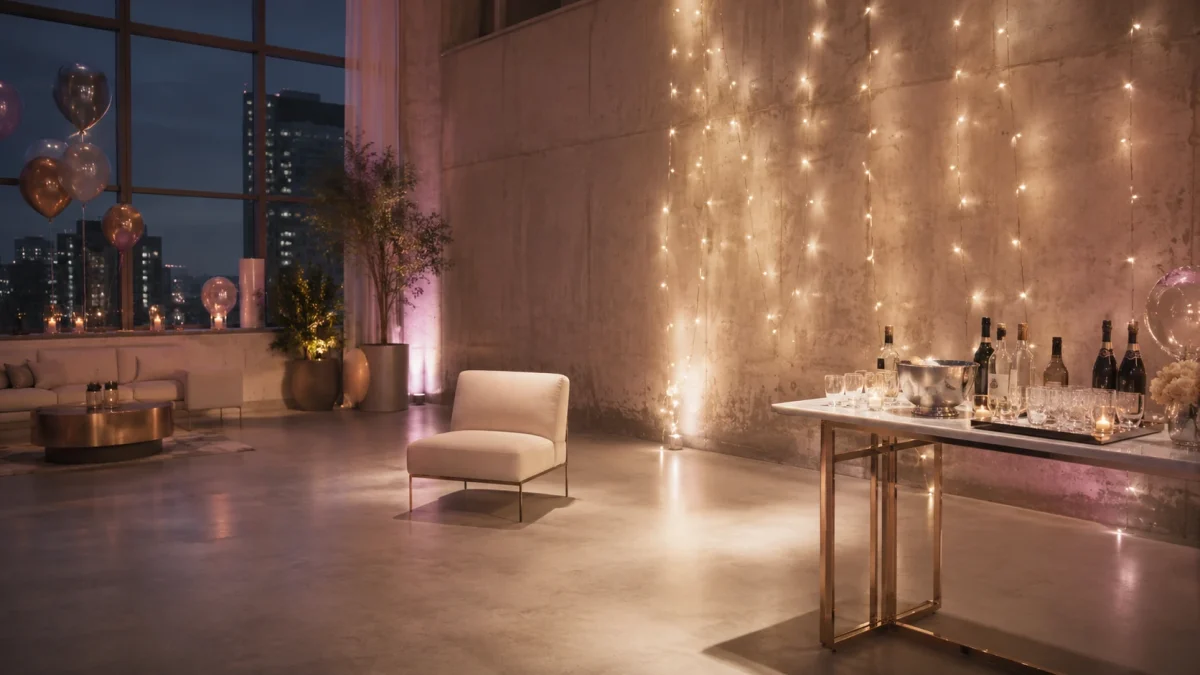
The physical preparation takes five minutes, and without it the evening is simply less good. Clear two metres by two — moving one sofa is enough. Find a stable chair without armrests; it is the single most important item on this list, because half the shows are built on it. Kill the ceiling light and switch on two lamps in the corners. And arrange a small place to change — a room, a kitchen or a large bathroom. If there is a bar or a table of food, place it well away from the performance area.
On the day: the timing
The golden rule: the show after the meal, not before. A fed crowd is relaxed, cheerful and ready; a hungry crowd watches the clock. The best moment is between one and two hours after the evening begins — in practice usually 22:00 to 23:00. If you start at a restaurant, give us the hour the meal ends rather than a booking time, and we schedule backwards. And do not plan the show while half the crew is still on the way — better to delay by fifteen minutes than to begin without people.
During the evening: what to do and what not to
Do: keep phones in pockets during the entrance — that moment is worth more in memory than in a story. Do: let the dancer run the room; she does it hundreds of times a year. Do not: pressure the groom into things he is uncomfortable with — that ruins evenings. Do not: drink too much before the show; the happiest crew is the one still present. And do not: try to change the agreements midway — the boundaries close in writing in advance precisely so that everyone feels comfortable.
How to choose a dancer for a specific groom
This is the question that most shapes how the evening feels, and it has a method. A groom who enjoys the spotlight gets an energetic style with crowd games. A groom who shrinks gets a themed entrance that starts from the side — a waitress, a neighbour, a technical inspection — so he is laughing before he understands. A mixed crew with women gets a style that is funny before it is seductive. And an older crowd gets elegance instead of volume. Describe the groom in two lines and you will receive two or three matches from the catalogue with reasoning for each.
The mistakes we see most often
Starting too early — half the crew is still on the way and the entrance is wasted. Telling the groom — the surprise is worth half the evening. Renting an enormous space for ten people — the show disperses and the warmth disappears. Drinking heavily beforehand — a drunk crowd does not remember, and that wastes the money. Not preparing a chair — it sounds small, but half the shows are built on it. These five recur again and again, and each is avoided by two minutes of planning.
After the show
The dancer leaves quietly, and you are left with a warm crew. Keep the show's music playing for another half hour — it was built to keep working. If you want to move on to a bar, this is the moment: the evening is already at its peak. And if something was not perfect, write to us directly and the coordinator who ran your evening will handle it. Crews that come back to us the following year do so precisely because of that: not because everything is always perfect, but because someone is accountable, in writing, from the first message.
The checklist in one line
How many, where, which groom — a month before. Format, dancer, exact hour — a week before. Address, floor, parking, contact — the day before. Chair, space, light, privacy — five minutes on the day. Everything else we bring. To see what it costs, it is all in our pricing guide and on the price list; and if you simply want to book, write to us and we will close it in three messages.
Frequently asked
A week ahead is comfortable, but two days works too. In summer and on weekends earlier is wise so the gallery choice is full.
A stable chair without armrests, two clear metres, two lamps instead of the ceiling light, and a small place to change. Five minutes of work.
After the meal, usually 22:00–23:00. A fed crowd is relaxed and ready; a hungry crowd watches the clock.
Especially then; just tell us. We have entrances built exactly for a shy groom, where he never stands at the centre for more than a minute.
Up to twenty in a living room; above that a loft or garden is better, and then a duo show is worth considering to fill the space.
Better not to. The surprise is worth half the evening, and it is our most repeated recommendation to organisers.
The bachelor package is 2,200 shekels, a solo 800, a duo 1,400 — final, in every city and at any hour, with no extras.